

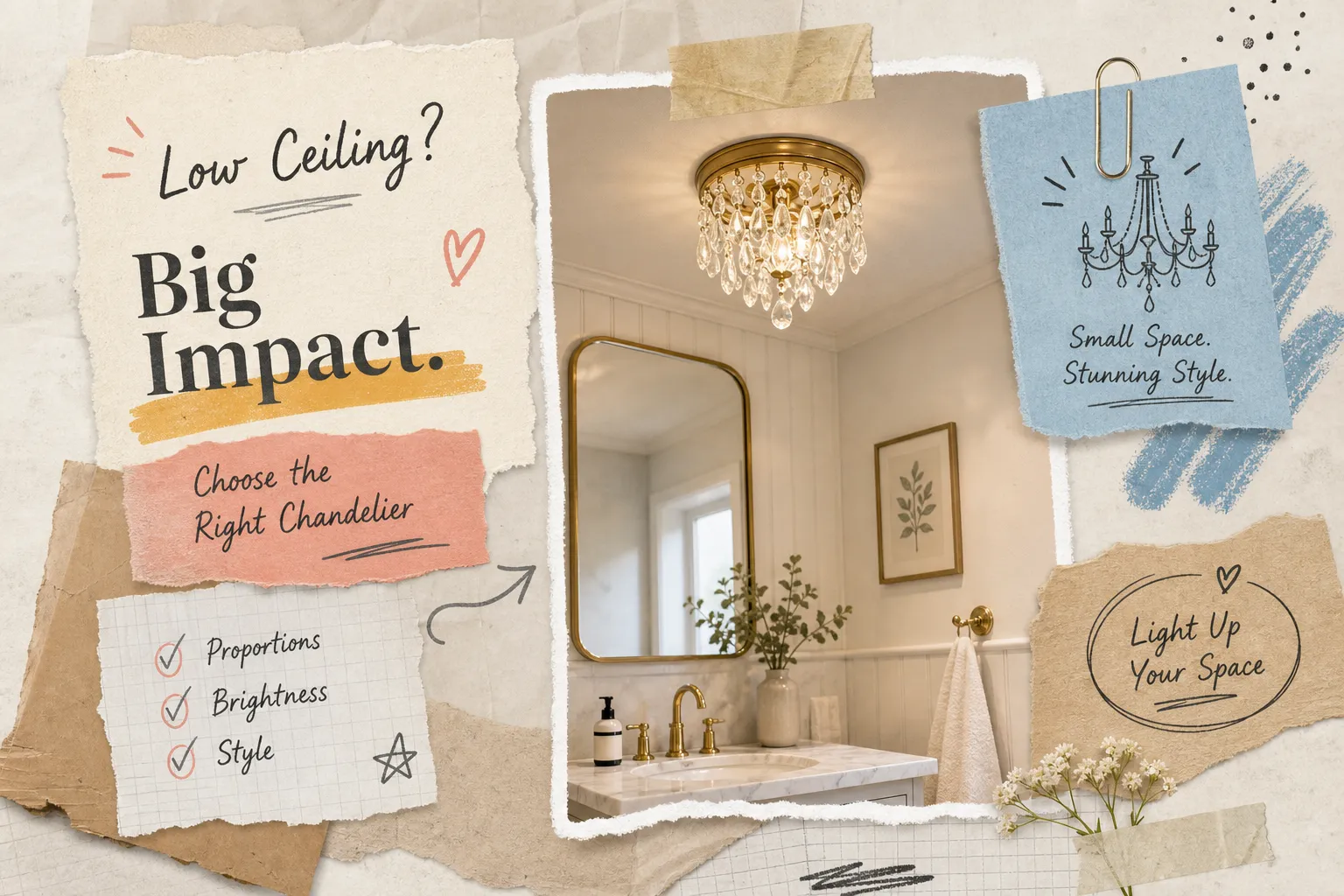
 Finding the best bathroom chandeliers for low ceilings can feel like a frustrating loop: fixtures that look perfect in a showroom photo can hang noticeably lower than expected once installed, dwarf the room entirely, or simply aren't rated for bathroom humidity. Many showroom chandelier photos are taken in rooms with nine- or ten-foot ceilings, which skews expectations fast. The good news is that finding the right fit comes down to four decisions made in the right sequence: mount style, safe clearance, correct sizing, and moisture rating. Work through those four in order and the noise clears up fast.
When off-the-shelf fixtures don't match a specific ceiling height or unusual room footprint, a custom chandelier service is worth considering early in the process, not as a last resort. This guide is practical and code-aware, built for anyone who wants a stylish bathroom fixture that won't create a safety problem or fail an inspection.
Why your mount style is the most important first call
The foundational decision unlocks everything else. That chandelier you loved in a magazine photo was almost certainly photographed in a room with a ten-foot ceiling. Replicating it in a low-ceiling bathroom starts not with style preference but with understanding which mount types are physically compatible with your space.
Flush mount vs. semi-flush: understanding the difference
Flush mount chandeliers sit directly against the ceiling with zero drop. They are the correct choice for any bathroom with a seven-foot ceiling because they keep the fixture as far from head height as structurally possible. If you're looking for a real-world example, our Faverelle Flush Mount Chandelier combines a low-profile design with handcrafted crystal flowers, making it an elegant choice for low-ceiling bathrooms where both clearance and luxury matter. Semi-flush fixtures have a short stem or rod, typically six to twelve inches, which introduces visual depth and elegance without a dramatic drop. Semi-flush can work for ceilings at eight feet, but clearance math must be confirmed before you commit: the drop needs to be tightly controlled so the bottom of the fixture stays at or above seven feet from the floor.
The practical rule: flush mount for anything under eight feet; semi-flush for ceilings at eight feet, with the drop calculated against your actual clearance allowance. For an eight-foot (96-inch) ceiling, subtracting 84 inches (seven feet) gives you a maximum allowable drop of 12 inches, but a conservative design approach often means targeting six inches or less so the fixture doesn't visually drag the ceiling down. That distinction alone eliminates most of the guesswork at the product selection stage.
Why standard hanging chandeliers don't work here
Pendant-style and chain-hung chandeliers are generally off the table for bathrooms under eight feet. The visual problem is real, but the safety concern is more pressing: hanging fixtures in low-ceiling bathrooms frequently reduce clearance below the minimums required by U.S. electrical code. There are exceptions, if the bottom of the fixture remains at or above the required clearance and local code is met, some pendant styles may be workable, but the typical production pendant isn't designed for these constraints. Establishing this early makes the rest of the selection process much more straightforward.
The clearance rules your bathroom chandelier has to meet
NEC 410.10(D) defines a prohibited zone that specifically applies to fixtures near bathtubs and showers. Understanding this zone doesn't add complexity; it eliminates fixtures that would never have worked anyway and focuses your search on options that will actually pass inspection.
The floor clearance rule and what it means for your ceiling
Standard design guidance holds that the bottom of any light fixture in a bathroom should maintain at least seven feet of clearance from the floor, a threshold widely used by lighting designers to prevent head contact and satisfy most local inspection requirements. For a seven-foot ceiling, that means zero drop, period. A flush mount is the only safe choice. For an eight-foot ceiling, the math works out to a 12-inch maximum allowable drop; however, a conservative six-inch cap is advisable as a design preference to avoid visually compressing the room further. Take your ceiling height in inches, subtract 84 (seven feet expressed in inches), and the result is your maximum allowable drop. Confirm that figure before you shop, then treat six inches as a visual guideline rather than a hard code threshold at the eight-foot mark.
The 3-foot bathtub and shower zone restriction
NEC 410.10(D) defines a horizontal zone within three feet of the bathtub rim or shower stall edge and eight feet vertically from the floor. Within that zone, hanging and suspended fixtures are prohibited unless the bottom of the fixture is at least eight feet above the floor, an exception that rarely applies in low-ceiling bathrooms. Only totally enclosed, damp-rated or wet-rated fixtures are permitted within this zone. Certain fixture types, cord-connected, chain-suspended, and track lighting, are explicitly excluded even if listed for wet locations. A flush-mount chandelier positioned above a vanity, at least three feet from the shower wall, handles this requirement cleanly. Move it toward the tub surround and the rating requirement escalates to wet-location compliance. Knowing where your ceiling box sits relative to the tub solves this before you order anything.
How to size the best bathroom chandeliers for low ceilings
Most bathroom chandeliers fail visually not because the style is wrong but because the diameter is off. A fixture that's too large overwhelms the room and makes the ceiling feel lower than it already is. One that's too small disappears into the space and looks like a placeholder. There's a reliable formula that lighting designers use to get this right.
The room dimension formula for fixture diameter
Add the room's length and width in feet, then convert that number directly into inches to get the ideal chandelier diameter. A five-by-eight-foot bathroom adds up to thirteen, so a thirteen-inch fixture is the target. A six-by-six-foot bathroom points to a twelve-inch fixture. This formula works for standard bathrooms and gives you a precise number to filter by when browsing product specs.
Drop length for ceilings at or below 8 feet
For a chandelier in a seven-foot ceiling bathroom, drop length is zero. Flush mount only. For ceilings sitting right at eight feet, keep the drop conservative, six inches is a sound visual target, and select a fixture with a low-profile canopy so the visual weight of the fixture doesn't pull the ceiling down further. Small details like canopy diameter and stem visibility matter more in compact rooms than they do in larger spaces, so read the full spec sheet before committing.
Moisture ratings: what damp and wet location actually mean
"Bathroom safe" is a marketing phrase, not a specification. It appears in product copy all the time and tells you almost nothing. What you need to confirm is the fixture's actual moisture rating, listed in the product's specification tab, because using the wrong rating in a steam-heavy space is both a code violation and a long-term safety risk.
Damp-rated vs. wet-rated: which one your space needs
Damp-rated fixtures handle humidity, condensation, and steam. They're appropriate for the main ceiling area of a bathroom, particularly above a vanity or away from the shower surround. Wet-rated fixtures are required within three feet horizontally of the tub or shower edge, or anywhere subject to direct water spray. For most bathroom chandelier placements centered on the ceiling above the vanity, a damp-rated fixture covers you. Move closer to the shower wall and wet-rated becomes mandatory.
What to look for in the product listing
Skip the product description and go directly to the Specifications tab. You're looking for the exact phrases "Suitable for Damp Locations" or "Suitable for Wet Locations", not synonyms or paraphrases. An IP44 rating or higher is a reliable secondary signal: it indicates protection against water splashes from any direction. Fully enclosed designs with no exposed sockets are standard for any moisture-zone installation and should be treated as a baseline requirement, not a premium feature.
Best bathroom chandeliers for low ceilings across every budget
The market for flush and semi-flush bathroom chandeliers is crowded, which makes it harder, not easier, to find good fits quickly. The goal here is to identify specific styles and features worth prioritizing at each price point so you can narrow your search without wading through irrelevant options.
Budget picks: best bathroom chandeliers for low ceilings under $100
Compact Sputnik-style and crystal flush mounts consistently perform well at the entry level. The VINLUZ Sputnik flush mount at 11.8 inches with zero drop is a strong example of a fixture that delivers visual character without any clearance compromise. The Q&S mini crystal ceiling light is another solid option for a more traditional aesthetic. At this price point, confirming the damp-rated label and IP rating is especially important: spec sheets at the budget end of the market are sometimes incomplete or inconsistent, so verify before purchasing.
Mid-range and high-end: where chandelier character comes through
The Pevfah Crystal Black Ceiling Light stands out at the mid-range for its compact design and ease of installation, offering genuine chandelier presence without a long drop. At the higher end, the Montego 6-light model with a 10.2-inch profile delivers full chandelier presence in a format that respects vertical space constraints. LED bathroom ceiling light options now dominate the mid-range: integrated LED designs with 50,000-hour rated lifespans and fully sealed housings handle bathroom humidity reliably and reduce the maintenance concern that comes with accessing a ceiling fixture in a compact room.
Integrated LED vs. replaceable bulb: the quick verdict
Integrated LED wins on longevity and humidity resistance. A sealed integrated design rated at 50,000-plus hours handles bathroom moisture better than an open socket and is the more practical long-term choice for a fixture you won't want to access often.
Replaceable bulbs offer one real advantage: if a bulb fails, you swap it without replacing the fixture. For low-ceiling bathrooms where ladder access is awkward and the fixture is hard to reach, integrated LED is the smarter default. If future-proofing the fixture matters more to you, a replaceable-bulb model with damp-rated LED bulbs and a corrosion-resistant finish is a workable alternative, but it requires more maintenance discipline over time.
When a custom chandelier is the smarter solution
The real problem many buyers hit isn't style selection; it's a mismatch between the constraints of their specific room and what off-the-shelf fixtures are built for. A chandelier with a four-inch stem when you need zero drop, or a canopy diameter that doesn't match the existing wiring box, turns a confident purchase into a return-and-reorder cycle. Standard fixtures are sized for average rooms, not a seven-foot-six ceiling or an awkward footprint where the room dimension formula yields a thirteen-and-a-half-inch target that no production model matches exactly.
How Happyarcadian's custom service solves the sizing problem
Happyarcadian's custom chandelier design service is built for exactly this scenario. You specify the exact drop length, canopy style, and fixture diameter your ceiling height requires, and the design is built to those measurements. For non-standard ceiling heights or unusual room shapes, this removes the need to settle for a fixture that's almost right. If you want to confirm pricing, availability, or process details, a consultation is the right starting point.
Who should consider going custom
If you've measured your ceiling, run the room formula, and confirmed that no ready-made flush or semi-flush option hits both the right diameter and the right drop, custom is the efficient path forward rather than a luxury add-on. Trade professionals outfitting multiple bathrooms in a new build benefit from the same service at scale: Happyarcadian's trade pricing and blueprint support are available specifically for designers and contractors working across multiple rooms and fixtures.
Bringing it all together
The sequence matters: choose your mount style based on ceiling height, confirm your clearance math against your actual ceiling measurement and NEC 410.10(D) where it applies, size the diameter using the room dimension formula, and verify the moisture rating in the spec sheet before you order. Work through those four steps and most of the bad options filter themselves out before you've spent anything.
The best bathroom chandeliers for low ceilings aren't the most expensive ones on the market. They're the ones sized correctly for the actual room, rated correctly for the humidity level, and mounted in a way that keeps the bottom of the fixture safely above head height. Style comes after those boxes are checked, not before.
If your ceiling height or room dimensions don't align with what's available off the shelf, explore Happyarcadian's custom chandelier options before settling for a fixture that almost works. Getting the drop length and diameter right from the start is always easier than returning a fixture that looked perfect in the listing photo but doesn't fit the room it's going into.


